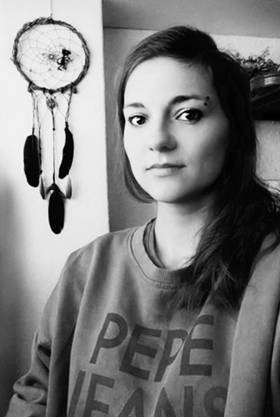
Anna, 37 years old, accountant.
City of Luhansk.
January 2022. Answers provided in Russian.
1. What was your summer like in 2014? What prompted you to leave or stay?
The year 2014 began very chaotically. We hoped that events would unfold with an intensity similar to Kyiv’s (there would be clashes, protests, and that everything would end within two to four months). But by the end of spring, it became clear that we were mistaken. We left in early June, and two key events contributed to this.
2. Is there a story of yours or your close ones that you would like to share? What struck you the most?
The first event.
Our daughter was born in winter, and in early spring we went to the children’s clinic for vaccinations. Leaving the intersection in Donbas (editor’s note – the name of the bus stop) from the yards near the Security Service of Ukraine office building, a very young guy about 18-20 years old with an automatic weapon stopped us. Our car had Kyiv plates as it was a work car, which put the guy in a somewhat unclear state: he started shouting at us, waving his weapon. My husband tried to talk to him calmly, showing our registration in Luhansk. However, the guy appeared to be under the influence of alcohol or drugs and behaved unpredictably. I sat with the child in my arms and was just frozen with fear: I was terrified that he might shoot – accidentally or intentionally – at one of us. Eventually, he ordered us to go home and then bring the car to their parking lot and leave it because “you shouldn’t f***ing drive with Kyiv plates here.” After this incident, we almost stopped leaving the house and barely used the car.
The second event.
Soon after, armed fighters began seizing military units, one of which was located near our home. I remember looking out of the window and seeing a mortar being transported directly beneath our house. Gunfire soon followed along the windows – most likely warning shots to prevent people from going outside – and it continued for a long time. Then a firefight broke out with soldiers who were barricaded inside the military unit, all of this taking place in a residential area. I was shaking with fear the whole time, fearing that anything could happen to us overnight. The night felt endless. I was relieved that our child managed to sleep and didn’t witness our distress. The next morning, it became clear that staying was impossible. We packed whatever we could fit into the car and left. At that time, we were selling a similar car of a different colour. We removed the Kyiv licence plates and installed plates from the Luhansk region, knowing that with Kyiv plates we would not be allowed to pass. We carefully hid the real plates inside our child’s clothes and later reinstalled them before reaching Ukrainian checkpoints. We passed eleven!!! checkpoints, including four Ukrainian ones. It felt like an eternity from a checkpoint to checkpoint. On one of the checkpoints, they were hesitant to let us through, and we had to wave with the little child. They grumbled, got annoyed, but eventually let us pass. After the checkpoints and all the anxieties, the road to Kyiv seemed to end almost instantly. That’s how we left, but 2014 had many more unpleasant surprises for us.
Once we settled in Kyiv, my mother came to visit us. On the very same day, railway connections were suspended – she arrived just in time. She stayed with us throughout the summer, under constant stress, as there was no regular communication with my dad.
My father survived in Luhansk as best he could. Once, he managed to hide behind a car just before shrapnel began flying. As a former military serviceman, he recognised the sound and reacted quickly. According to his stories, bodies lay on the streets because there was no fuel to transport them; there was no electricity and no water. He had to move to the dacha, where they gathered with friends, cooked food, fetched water, and survived as best they could. My sister lived in Stanytsia Luhanska, and they stayed there until August. In early August, on her birthday, she was preparing a festive dinner. A friend emerged from the basement, where she had been staying and working remotely. While my sister’s friends remained outside smoking, she went into the house to prepare food. “The room suddenly went dark; something crumbled from the window.” When my sister and her family realised what was happening, they quickly hid. After everything quieted down, they waited for another 15 minutes and rushed outside. Both of my sister’s friends remained sitting on a bench in the same position, with several shrapnel pieces in their bodies, which turned out to be fatal…
In the fall, we received news that a shell hit the house where my husband’s father had lunch with friends on that day. A close relative (my father-in-law) lost his life. At that moment, all the anger and hatred were boiling inside, and there was a desire to cry out of helplessness… It was a very difficult summer. Besides what was happening at home, the situation outside was much worse. People were very irritated, and it was always uncomfortable to say where you were from because many reacted inadequately. Some blamed us, personally, and people like us for the war – it was so unpleasant to hear, especially bearing the burden of what we had experienced. We were insulted, called bandits, and my sister’s car was smeared with paint. Then, no matter what happened, displaced people from Donbas were always blamed: if someone was killed, something was destroyed, someone was robbed, it was often attributed to “residents of Donbas…”
3. How did the year 2014 change your life?
The year 2014 left a deep wound, and time does not heal it. It only quiets for a while, but there are moments when it breaks open again – and you simply want to cry out all the pain and scream out all the anger.
4. If you had the chance to go back to 2014, would you do something differently? If yes, what specifically?
I know that on a global scale, I probably could not have influenced the situation significantly. Most likely, I would have tried to do something, but above all, I just wanted to protect loved ones, friends, and acquaintances…
It’s painful to know we couldn’t save those who are no longer with us. That is something incredibly hard to accept. But in the end, I have nothing to regret now.
They took our home, pulled us out of our lives. Luhansk may not have been the best city in the world, and many people dreamed of leaving it. But when you are forcibly expelled from your own life, a strange feeling arises – you no longer know where your home is. We set out to find a home in another country (editor`s mark – Spain) – and we found it.
5. How do you feel about your life now? Do you have any regrets?
We relocated to Spain, built a new home from a blank sheet. We tried persistently to move forward, trying to find the positive in everything. Because the scariest thing is to close yourself off, enter your cocoon, where grief, anger, and depression will simply poison life and consume it until they change your personality beyond recognition.
6. Do you plan your future? If yes, for what term?
All this time, we didn’t make long-term plans; we just went with the flow and saw what would happen. Only for trips, we prepared in advance.
And just as we started making plans “for the future,” COVID immediately erupted, which also changed a lot. However, we are still building plans, just now there are some that require looking far into the future, and others. So you plan something, but as the old saying goes, “Hope for the best, but prepare for the worst.”
I would like people to look at us, at all of us, from a different perspective. I hope they don’t consider us enemies and traitors
.
January 2024. Responses provided in Ukrainian.
1. On February 24, 2022, a full-scale invasion of Ukraine by Russia began. What was this day like for you? What were your feelings, and how did you react?
As usual, I woke up and went to the shower. When I came out, my husband told me that the war had started. Even earlier, in December, we had talked about the Russians moving military equipment to the borders. I was gripped by fear then, and I said, “Something is going to happen.” To which my husband and friends said it’s just a show… how cool it would be for me to be wrong. I just went into hysterics and couldn’t stop for twenty to thirty minutes. Then I started flipping through Telegram channels (at that time, I had only one or two with Ukrainian news). Flipping, switching to others, and others and others – I got lost in the news. And then it hit me like a shock, and I realised – it’s Ukraine. Anya, damn it – my friends, family, acquaintances are there… I started calling and texting everyone whose numbers I could find. In the evening, I realised that life had split into “before” and “after.”
After all the news on the first day, there was so much rage, and it only continued to grow. Even news about unknown innocent people being killed shattered my heart. And this was me waking up in Spain – I cannot even imagine what people in shelled houses were feeling.
2. Were you forced to leave Ukraine (perhaps temporarily)? If not, proceed to the next question.
If yes, share your experience abroad: were you in one country the whole time, did you move to several countries, did you have to learn a new language, adapt to a new profession, etc.? Where are you now? Do you plan to return to Ukraine when the military actions end?
We moved to Spain in 2015. Some people told us that there was no war in our country. It was extremely irritating that many people, unfamiliar with the geographical divisions of the former USSR, called all of us Russians. I constantly had to correct them. It was very difficult to adapt to a new country with a new language. But the Spaniards are wonderful – they were very supportive both back in 2014-2015 and again in 2022. I volunteered and felt the support when we marched with flags – many people applauded and shouted, “Putin is a killer.” After living abroad for seven years, having a home, a job, and a family, I still feel that my home is there, in Ukraine. But, as I said in January, “the thing is – I have no home.”
It feels like you belong to two countries and to neither of them. In Spain, we will always remain newcomers, and in Ukraine, you are the one who left the country.
As for work, it turned out quite interesting. I learned a new profession that I really enjoyed, worked in it for several years, and then returned to my Ukrainian profession as an accountant, because it pays better. It was an opportunity to see how it would work out. In fact, I would like to return to Ukraine. After the full-scale invasion – even more so, because I saw how society began to change dramatically for the better. Changes started both in thepolitical and social spheres. Slowly, but they are happening. Ukrainian society has “grown up.”
But so much time has passed, and I do not know whether I will be able to leave everything again and start from scratch in Ukraine. My daughter, however, dreams of living in Ukraine when she grows up – and that is so touching.
4. What changes and transformations have occurred with you (if any) as a person during these two years of full-scale invasion?
On the one hand, one could say that there were significant changes, but on the other – none at all. It feels as if the Russians, through their actions, simply opened Pandora’s box – something that lies deep inside everyone. They released such evil, such rage and hatred that I did not know how much of it I could contain. That it was even possible to hate someone so much. There was a lot: survivor’s guilt, a pre-depressive state (perhaps even depression), tears – so many tears.
But all that rage gave me strength. After work, it helped me assist refugees: protests, conversations, sorting supplies in warehouses, explaining to Spaniards what had happened, meetings with donors, appearances on television and radio – wherever we were invited, we always went, filling every possible space with yellow and blue so that we would be heard, seen, and so people would know that Russia was killing us.
That rage helped me overcome exhaustion, sleep a little, and in the morning it gave me the strength to get out of bed. As for my mental state – I sought a psychologist, because it was frightening.
5. If you could go back to 2014, would you do anything differently?
I thought a lot about what I could have done in 2014. At that time, I was not politically mature enough. We were taught that politicians should deal with politics on their own, as long as they did not interfere with our lives, and we would not interfere with theirs.
The Russian propaganda machine was extremely powerful. With the experience I have now, I believe I should do everything possible to build strong resistance, to create ultra-engaging but effective pro-Ukrainian propaganda. Something… I would do something.
I feel ashamed – ashamed that I did nothing. Perhaps this shame will stay with me until my last breath. But I know that in 2022–2023 I did as much as I could, and I will not be ashamed of that.
6. Do you plan your future? If yes, for what term? How do you envision the future of Ukraine?
In some things – yes; in others – no. When it comes to possessions, I gradually buy things like a compass, a folding knife, some emergency food supplies, a small generator, a flashlight.
But when it comes to actions – no. There are big plans that simply need to be realised one day, but on the level of everyday life, it is more like improvisation. Sometimes you do not plan things – you just act. And sometimes you cannot gather yourself to plan anything at all.
Plans have been falling apart since 2014 – a year when I never planned to leave the city of Luhansk. I was fine there. So plans are plans, but life has its own way of deciding.
I see a great future for Ukraine – a great country of great people: wounded, enraged, hurt, but powerful. The whole world has learned about Ukraine and Ukrainians, and many are shocked by how strong we are – our military, our volunteers.
A new foundation for society is being formed now, one that future generations will rely on. This new foundation, earned through the blood and lives of many good people, will be laid upon the ruins of the past.
I want society to continue putting even stronger pressure on the authorities and to fight corruption, thieves, and all those who enriched themselves at the expense of the war. I believe in victory – not that it will be easy or soon, but I know it will come. There is no other way!
The audio format of the stories will be available on the Unveiled Ukraine YouTube channel.