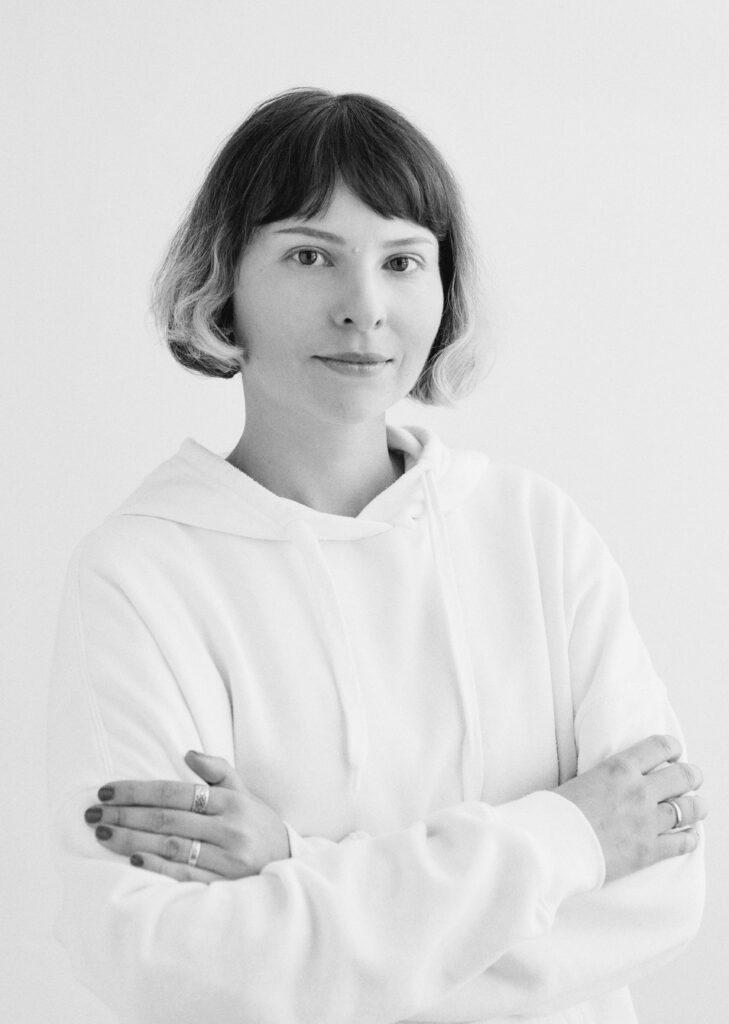
Alevtina, 39 years old, artist.
Luhansk city.
January 2022. Answers provided in Russian.
1. What was your summer like in 2014? What prompted you to leave or stay?
The summer of 2014 in Luhansk started alarmingly.
Several explosions had already occurred in the city. At night, sirens were sounding, and planes were flying. Automatic gunfire could be heard under the windows at night. ATMs were being looted. Unknown people (non-locals) seized the Regional State Administration (editor`s note – ODA in Ukrainian) and the Security Service of Ukraine (SBU). They organised checkpoints where they stopped ordinary civilians, confiscated cars, and detained people, taking them to the basement of the ODA, where they were held and interrogated. My husband’s family and I gathered in early June to decide what to do. We considered leaving, as I had a very young daughter – just one and a half years old – and I did not want to expose her to danger
2. Is there a story of yours or your close ones that you would like to share? What struck you the most?
About a week after our conversation, my husband’s father decided to go to his summer house (Khristove village, Shchastia direction). It was Friday, 13 June. On 14 June, he did not return home. We lost contact with him, and his phone was not answering.
We were all deeply worried, as nothing like this had ever happened before, and we also knew that there was a checkpoint on the road towards Shchastia. My father-in-law, Konstantin, worked for a large company with its own security department. My mother-in-law contacted them, and it was possible to track a person’s location via a mobile phone.
As a result, we discovered that my husband’s father was in the captured Regional State Administration (ODA) building of Luhansk. On the same day, 14 June 2014, my husband’s mother went there. When she arrived at the Regional State Administration of Luhansk, she was met by unknown armed people in military uniforms, who verbally abused her. During the conversation, one of them confirmed that yes, indeed, such a person was being held in the basement of the administration. They were holding him hostage, calling him various names such as “Right Sector” and others.
They refused to release him.
The car my father-in-law had been driving was seized by the invaders. In addition, a company car from the garage – whose keys were with my husband’s father – also disappeared. The next day, when my husband’s mother came to the Regional State Administration (ODA) again, the invaders said that there was no father there. They didn’t ask for any ransom.
They simply said that we didn’t know such a person.
Almost eight years have passed since that event, but our father has never returned.
Our entire family continues to mourn and wait for him. We carry psychological wounds that will last a lifetime.
We never imagined that something like this could happen. It all felt like the script of a dramatic film.
3. How did the year 2014 change your life?
A few days after the disappearance of my father-in-law, my husband, our little daughter, and I left Luhansk. We headed to Kyiv, believing it would be for two months. Instead, we stayed and have been living there for almost eight years. I am deeply grateful to the kind people who helped us in Kyiv – my sister, as well as those who were strangers to us at the time but provided housing and various forms of support.
4. If you had the chance to go back to 2014, would you do something differently? If yes, what specifically?
Could I return to Luhansk? I don’t think so. There is nothing left there that holds me. When I think of my hometown, all I feel is bitterness, pain, and tears in my eyes. If I could return to June 2014, to that family meeting, I would insist that all of us – parents and children alike – leave Luhansk immediately.
5. How do you feel about your life now? Do you have any regrets?
Now I have no regrets, and I am glad that I did not stay in Luhansk. I live in a modern, developed European capital – Kyiv. I like living here. My husband and I work for a successful company, and our daughter attends school. Here, I feel safe.
6. Do you plan your future? If yes, for what term?
I plan my future in Kyiv. It’s challenging to plan ahead in our “turbulent” world, but still, I believe in a bright future! Love, peace, “peace forever”! People, love each other and our beautiful planet!
January 2024. Responses provided in Ukrainian.
1. On February 24, 2022, a full-scale invasion of Ukraine by Russia began. What was this day like for you? What were your feelings, and how did you react?
On February 24, 2022, my husband and I woke up to two explosions. My daughter and I felt nauseous, and we had no appetite. It was a working day. My daughter was supposed to go to school, but I had to tell her, “Sweetheart, you’re not going to school today because a war has begun!” I was very frightened! I called my mom. We didn’t know what awaited us, what the situation was. My husband turned on the radio. We listened to the radio and read news from various platforms at the same time. My mind was racing. We tried to find out what was happening, what the current situation in the country was. It seemed like Russian soldiers with guns were already around the corner of our house, ready to shoot everyone!
Then we went down to the basement. We didn’t leave the house for 10 days
2. Were you forced to leave Ukraine (perhaps temporarily)? If not, proceed to the next question.
If yes, share your experience abroad: were you in one country the whole time, did you move to several countries, did you have to learn a new language, adapt to a new profession, etc.? Where are you now? Do you plan to return to Ukraine when the military actions end?
It was simultaneously scary and difficult, but I made the decision to leave with my child abroad. On March 6, we left home, not knowing what awaited us or if we would make it! My husband stayed in Kyiv. At that time, he had already joined the Territorial Defence Forces. We arrived in Liechtenstein, where we still reside. My daughter and I had to learn the German language. We are very grateful to the government of Liechtenstein and the ordinary Liechtensteiners! They warmly welcomed us and helped us. But my soul hurts, and it longs for home – Ukraine! During all this time, my husband and I are forced to live separately. I dream of our family finally reuniting! For our daughter to live with both parents. When the war is over, we plan to return to Ukraine!
4. What changes and transformations have occurred with you (if any) as a person during these two years of full-scale invasion?
At the beginning of the war, in the first days, we hoped that this madness would end quickly. I couldn’t believe that in the 21st century, in the modern world, such a thing could happen – when a neighbouring country and your neighbours would come to kill you! But time passed, almost two years have gone by, and it is still happening! It’s very painful! Yet we are holding on! In the early days of the war, I tried to find meaning in life for myself. It was very challenging psychologically. I experienced panic attacks in the middle of the night
5. If you could go back to 2014, would you do anything differently?
I don’t even know if I would change anything in 2014. I believe I did everything right for myself – the way I felt in my soul.
6. Do you plan your future? If yes, for what term? How do you envision the future of Ukraine?
At the beginning of the war, I planned my future for a maximum of one day – lived through the day, and thank God! But I understand that planning the future is important for my mental well-being now. I try to do so. I engage in psychological training and practices, engage in yoga – it helps. I don’t know what awaits our Ukraine next to such a neighbour, but I want to believe in a bright future because we love our home – Ukraine and want to live in it. During my time in Western Europe, I realised the advantages of our homeland and began to appreciate it more.
Glory to Ukraine and glory to the heroes!
The audio format of the stories will be available on the Unveiled Ukraine YouTube channel.