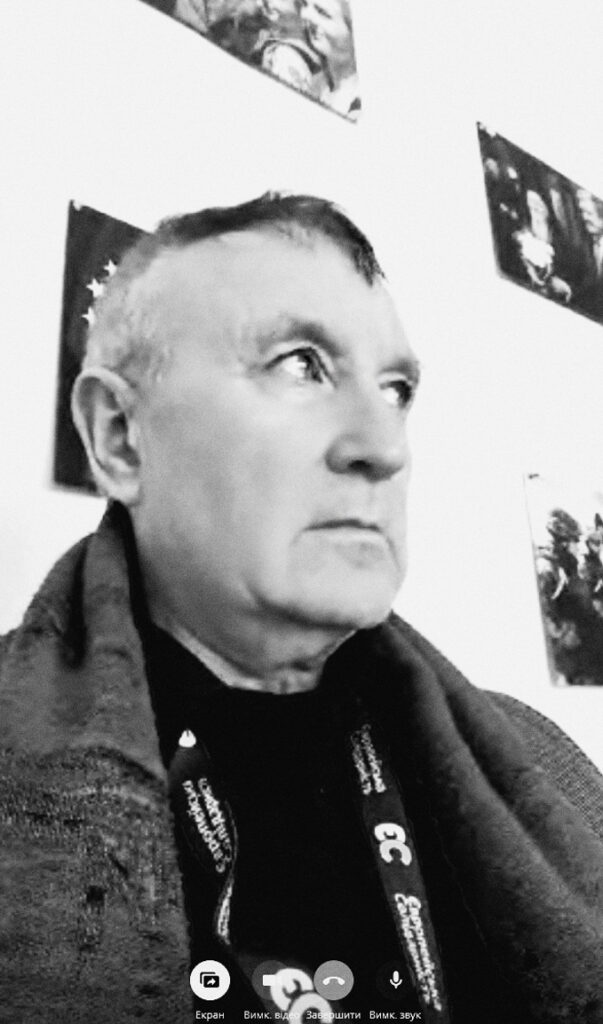
City of Luhansk.
January 2022. Answers provided in Ukrainian.
1. What was your summer like in 2014? What prompted you to leave or stay?
In 2014, I was the head of the district election commission for the presidential elections in Ukraine on behalf of Petro Poroshenko in election precinct under number 105 (Artemivskyi and Kamyianobridskyi districts of Luhansk), where I organised the elections and opposed the conduct of the so-called “referendum.” In addition, I was the head of the regional organisation of the Ukrainian People’s Party. Around 4:00 PM on May 15th, I was warned that a group of militants was coming to arrest me at the district election commission. I was forced to leave Luhansk and move to the village of Polovynkyne in Starobilsk district, where the territorial defence battalion was being formed, later named “Aidar.”
2. Is there a story of yours or your close ones that you would like to share? What struck you the most?
Viktor ZORYA from Krasnyi Luch: worked as the head of the city election commission and was the head of the city organisation of the political party UNP. He climbed onto the roof of the city executive committee building to restore the state flag that separatists had removed. Naive, he thought it was just the antics of local troublemakers, not the beginning of full-scale aggression by Russia against Ukraine. The mayor of the city publicly expressed a desire to see Putin’s tanks on the streets of the city, and three residents of Krasnyi Luch became ministers in the first so-called “LNR” government. He was arrested, beaten with sticks in the basement of the city executive committee, and they thought they had killed him. Cleaning ladies carried out the unconscious body, and in the trunk of a van heading to Kharkiv for goods, they took him out of the city. On July 29, 2014, he came to me at the “Luhansk-1” battalion, where he served as the deputy for personnel, barely alive and blue from beatings. We nursed him back to health and enlisted him in the battalion, with which Viktor went through the military path until 2016. He continues to fight as part of the Armed Forces of Ukraine.
3. How did the year 2014 change your life?
Life before the war and after the onset of the war. My father fought. I grew up on his memories of the horrors of war, trenches, mud, the smell of festering wounds, and the loss of friends. Despite having an education in history, political science, and sociology, I never believed that there would be war with Russia.
But it happened!
Alexander Paschaver said that, like Jews, we need to learn to coexist with a GREAT danger (for them, it’s the Islamic world that doesn’t want to see the Jewish state; for us, it’s an empire with a mad leader that doesn’t want to see an independent Ukraine).
4. If you had the chance to go back to 2014, would you do something differently? If yes, what specifically?
I don’t want to change anything; my main problem is my AGE (65), and a conviction for weapon possession – that’s why I can’t go back to fight in this country.
5. How do you feel about your life now? Do you have any regrets?
I regret nothing. It’s not fitting for a man to complain…
6. Do you plan your future? If yes, for what term?
Yes, I plan to be socially active and help in the formation of Ukraine, however pompous it may sound: I will still be able to talk to young people and hold a weapon in my hands.
GLORY TO UKRAINE!
January 2024. Answers provided in Ukrainian.
1. On February 24, 2022, a full-scale invasion of Ukraine by Russia began. What was this day like for you? What were your feelings, and how did you react?
On the 24th, I was living on Mayakovsky Street (Severodonetsk – Editor’s Note) near the “Ice Palace.” A friend from Kyiv called me and said that war had begun. I went to the ATB store to buy food for my cat. On the way, we were shelled with rockets, like the rest of Ukraine. A woman covering her child on “Hvardiyske” (avenue) was hit. People in the ATB were grabbing everything they could. In the evening, we gathered in the square against the Russian aggression. There were only 7 of us, including 4 women. The city was empty: no authorities, no so-called “law enforcement” – nobody…
Near my house, some young guy was telling neighbours how good it would be with the Russians, that they would give citizenship to everyone. I twisted his muscles, but there were mostly those who were waiting for Putin. In the morning of the 25th, I went to Lysychansk to the Territorial defence (TRD): that’s how my second war with combat clashes in Rubizhne and injury began.
I gave the cat to acquaintances near Lake Chyste, which is the advancing zone of the Russians, with constant shelling. They left, handed over the keys, and left as well. In two months, I found the cat in a demolished apartment without windows, barely alive, tied up with a rope: I wasn’t sure she would survive, but I took her with me to the brigade. She barely came out in a month. The city was completely destroyed. The Ice Palace resembled “Stalingrad.”
I learned that Shchastia was captured, later my battalion kicked them out from there. My friend – Ira Gordiyevich – was killed there.
3. What motivated you to stay in Ukraine? How were these two years of full-scale Russian invasion in Ukraine for you? What is your current emotional state?
We needed to fight. Unfortunately, a brigade is a few thousand people, and there were barely 600 of us. Four battalions, mostly elderly – no one wanted to fight. I mean the Territorial defence. We needed to fight both in 2014 and in 2022.
4. What changes and transformations have occurred with you (if any) as a person during these two years of full-scale invasion?
Initially, I participated in combat, then got a concussion. I lied a bit that I was 60; after the concussion, I was already 65, so I was discharged due to reaching the maximum age. I am in Ukraine, at my relatives’ dacha near Kyiv. The morale is very tough. It’s been tough for me since March 2019, from the elections. But that’s a separate issue because when people chose Zelensky, it was a shock for me, and it still hasn’t passed. Someday time will pass, maybe someone will talk more about it.
I also want to say that the situation is like it was in 2015 when I sat on a suitcase waiting to return to Luhansk. Then it passed, and I realised I wouldn’t return to Luhansk. And now it’s the same. For about a year or so, I was waiting, thinking that we would return to Severodonetsk. Let it be destroyed, but it needs to be restored and rebuilt – someone has to do it. But now there’s already a thought that we won’t return there. And age, age… I wanted to go back to war, even went to Danyliv, the Secretary of the National Security and defence Council (NSDC), he’s a fellow countryman, a good acquaintance. He called generals, tried various options, but still, it’s the age, and you can’t go anymore. I wanted to go as a chaplain later, but it didn’t work out either… the age.
5. If you could go back to 2014, would you do anything differently?
I wouldn’t change anything. I volunteered in May 2014 and fought for four years. And I would go again.
6. Do you plan your future? If yes, for what term? How do you envision the future of Ukraine?
I believe Ukraine will endure, but within which borders? I believe in Ukraine and its future. I want to say more: there is a small country, the Netherlands, where two generations fought against Spain, but they won their independence, autonomy, and perspective. I don’t know how long we’ll have to fight, but we need to go through it.
The audio format of the stories will be available on the Unveiled Ukraine YouTube channel.