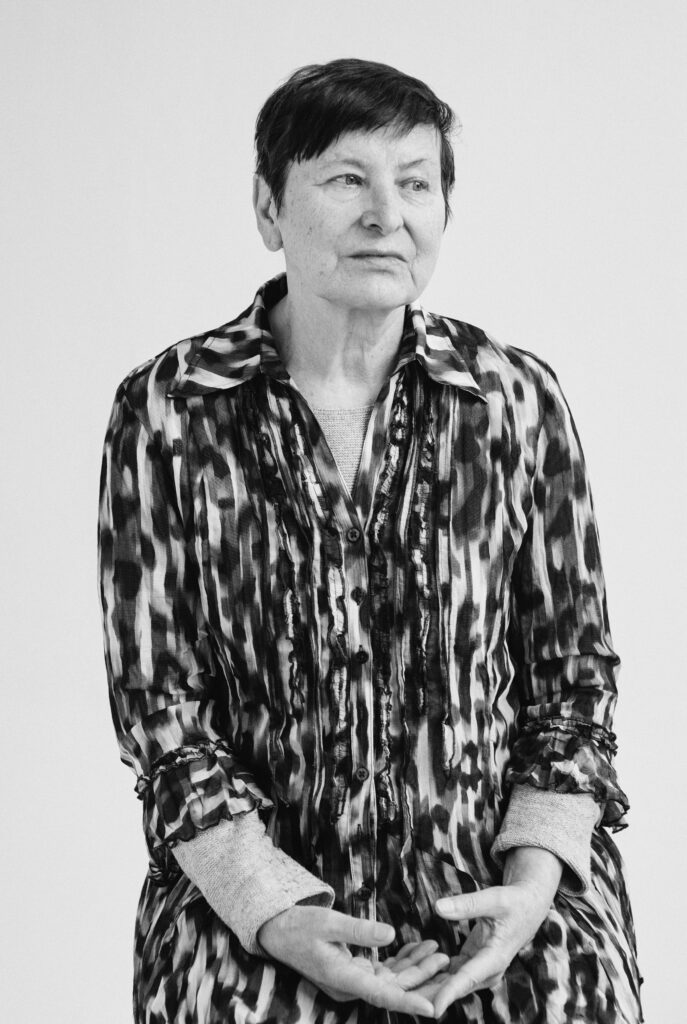
Anastasiya, 77 years old, retired.
Luhansk city.
January 2022. Answers provided in Ukrainian.
1. What was your summer like in 2014? What prompted you to leave or stay?
Summer 2014 was distressing. An occupant came to my land. I couldn’t abandon my disabled brother in the occupation. But where to take him? Not to Russia, and to Ukraine – where?
2. Is there a story of yours or your close ones that you would like to share? What struck you the most?
July 2014. Heat. The air seems to have stopped.
Electricity, water, and communication were off.
Every day starts with a trip for water with my neighbour.
The 5-kilometre journey, short and endless, may expose us to militants’ shelling.
Our path weaves through the blocks between houses, avoiding prying eyes and main roads. Returning home with water-filled bottles, we use the same cautious route.
Our only transportation aid is a “kravchuchka” (editor’s note – slang for bags on wheels).
We carry this treasure (water) – I to the 4th floor, my neighbour to the 5th. Closer to evening, militants initiate artillery shelling from the forested area targeting civilians and their homes. People are bewildered and oppressed. Communication with relatives is absent due to the lack of network. Everyone wishes to know what awaits them, what happened to their families, where they are?
We knew where ours were, but their fate was uncertain.
My neighbour started to panic. She cried like a small child who lost her family. I asked, “What happened?”
The tears suddenly stopped. With a face like a statue and a detached look, she calmly said, “I’ve decided everything. I don’t want to live in constant fear and see the occupier. I’ll jump from the 5th floor, and it will all be over.”
I said in a cold voice, “I didn’t know you were such a selfish person, unseen in the world. Yes, for you, the war, everything happening here, will be over. Have you thought about your children, grandchildren, mother, sister? Your children will blame themselves for leaving you in Luhansk for the rest of their lives. Because you wanted to protect your belongings, help your sister take care of the elderly mother.”
I did not expect such a reaction, but my speech hit her like a cold shower. I haven’t heard anything similar from her since then.
July ended. August took its place. The war continues. The heat stands like in a desert. There is no rain cloud in the sky, only the stench and heat from gunfire. Water, electricity, and communication are absent. Gas is not everywhere. People gather together because it’s better for survival, helping each other. You can immediately see the true face of people.
In the streets of the eastern quarters of the city, there are almost no people, only about a hundred people at the market. Some are selling, others are buying.
I hear a cry; a column of Russian paratroopers on BMP is coming. Russian flags on combat vehicles. The defenders of the “Russian world” have rainbow smiles on their faces. The crowd freezes. They stand as if at a funeral. Grey faces. They lower their eyes to the ground; only two young people kindly greet the invasion. I can’t stand this silence — a scream of complete hatred bursts from my chest: “Russia, occupier! Get out of my city!” The screech — the cannon turns towards me. The smirk of the Russian occupier turns into a grimace. On my face, you can read that they shouldn’t expect help here. Someone’s hand pulled me with such force that I almost fell. It was my neighbour Olena. The crowd froze, expecting shots. But there were none.
In my head, a plan to resist the occupier was already born. The rashists occupied my city, but not everyone submitted.
The plan that matured in my head was gradually being implemented in life.
Every evening, under the light of a solar lantern, I wrote pro-Ukrainian postcards sized 6×3 cm: “Russia, occupier, Luhansk is Ukraine. Ukraine will not abandon us,” and drew Ukrainian flags.
I distributed this entire treasure in places where people gathered — the market, the entrances of multi-story buildings, and electrical panels. I built conversations with residents in such a way as to know whom they supported. Traitors — their data went into the list. I found out where the troops and equipment were located.
My work in the rear gradually moved forward. The question arose of how to transmit this data to our Ukrainian military. Just approaching a checkpoint was risky. That’s how, in February 2015, I returned from Lysychansk to Luhansk. The road at that time was long and took several hours. Next to me on the bus sat a young, beautiful woman with blue eyes. Those eyes radiated pain, separation, and sorrow. We started talking. Yes, she had seen death, blood, the ruins of homes, constant anxiety because her girls were nurses. They provided first aid and evacuated wounded soldiers to planes, which then transported them to hospitals in Dnipro or Kharkiv.
Natali asked, “How is it in Luhansk?”
I replied, “We are losing in the information field.”
The Russians placed leaflets on every building pillar: “Russia, brother, the Russian-speaking population will never leave and will defend against Bandera supporters. Russia will help turn Donbas into a little Switzerland.”
“Natali, you understand, I need leaflets, and our defenders need to know everything that is happening there. Please, help. Here is my phone number; let them contact me. Tomorrow I will be crossing the checkpoint of the militants.” As if God himself heard me. That evening, I spoke with the soldiers of the “Aidar” battalion. That’s how my underground intelligence work in the enemy’s rear began.
I refrained from getting acquainted with other voluntary assistants of the Ukrainian army who were residing in Luhansk at that time. We agreed on a method of information transmission: the concentration of military equipment, troops, and their movements through coded words known only to the commander. This information had to be transmitted immediately even in the presence of militants.
Twice a month, I met with the commander at the base. Crossing the militants’ checkpoint was very tense and sometimes took up to 7 hours. The crowd of people could stretch for 800 metres from the monument to Prince Igor to the bridge over the Siversky Donets River (Description of the checkpoint area in Stanytsia Luhanska – Author’s note). People moved in a column of 10 people in a row. It was a diverse crowd of mostly older people—pensioners moving to Stanytsia Luhanska, and some further to get their pensions and buy cheap, quality products. Most were supportive of the occupiers—pensions in Ukraine and in the so-called Luhansk People’s Republic. They hoped that Russia would embrace Donbas into its fold, just like Crimea.
In Stanytsia, the commander greeted me with his team, and we went to the base. There, I presented a photo report on the completed work and received another batch of leaflets. Sometimes I asked the commander to make the leaflets palm-sized and with adhesive backing.
With a new batch of leaflets, I returned to Luhansk.
At the militants’ checkpoint, all items from the bag were laid out on the table. Among the carefully checked items were pro-Ukrainian leaflets. Everyone was checked, except for the suppliers of fruits and vegetables because they paid. They were allowed through without waiting in line. After successfully crossing the checkpoint, I called the commander from the bus. These were my words: “Sunshine, I’ll be home in 10-15 minutes, prepare something to eat because I’m very hungry.” This way, the commander knew everything was okay. For my comrades, I bought the militants’ uniforms, SIM cards, topped up their accounts—necessary for excursions into the occupied territory.
I distributed leaflets in all areas of the city. Over three years, thousands of leaflets were distributed. The leaflets varied. There were appeals to the militants with phone numbers, urging them to switch to the side of Ukraine and fight against the Russian occupant. It was painful to see how the occupier shot peaceful people in broad daylight. In one of the summer days of 2014, in broad daylight at the intersection of Budyonny-Koroleva streets, a militant’s car stopped, fired a grenade at people, and continued driving. Arms, legs, and heads scattered in different directions. The militants did not let the bodies be covered until Russian reporters arrived. They didn’t even bother looking for that car. There were many of them at that time. It was said that Ukrainian banderofascists were destroying Russian-speaking citizens. Among the dead was my acquaintance. Her relatives live in Boryspil.
This was not an isolated incident, but everything was blamed on Ukraine. Then came captivity.
3. How did the year 2014 change your life?
My life has been divided into the periods before the war, life during occupation, captivity, and life after captivity.
4. If you had the chance to go back to 2014, would you do something differently? If yes, what specifically?
Had I been more cautious, I would have continued to fight alongside my defenders against the occupant.
5. How do you feel about your life now? Do you have any regrets?
It’s like being a bird released from a cage but with clipped wings. The actions and words of the authorities are striking; they say there was no need to get involved (to help the Ukrainian army in the fight against the occupant). There is an army that receives funds; they should do their job, and then we wouldn’t have suffered. Homes, my deposits, and everything else would have remained.
We were equated with the internally displaced persons, with the thief Yeremenko and those who were in the ranks of the “Zarya” militants. Do I regret it? It depends on the perspective.
6. Do you plan your future? If yes, for what term?
There are many plans, like those of “Napoleon.” To legalise my work with the Ukrainian intelligence, recover everything that was taken, and most importantly, my neighbour and I dreamed of seeing the day when the Russian invaders would be punished and would ask for forgiveness from us, Ukrainians.
January 2024. Answers provided in Ukrainian.
1. On February 24, 2022, a full-scale invasion of Ukraine by Russia began. What was this day like for you? What were your feelings, and how did you react?
On March 1, 2022, I had planned to move to Irpin to the accommodation provided by a friend from Luhansk. The apartment was in a new building, not yet ready for comfortable living, but it was a roof over my head, where I could have my own space. I had to do some things myself: wallpapering, nailing skirting boards, hanging curtains to make the apartment cosier. My friends brought a refrigerator and a washing machine. I still needed to buy an electric stove and a sofa to have a place to sleep. On February 23, at 11 PM, they installed a stretch ceiling there. I returned to Kyiv at 1 AM, and at 5 AM, I heard the roar of planes and gunfire. The war caught up with me in Kyiv. I knew that Russia would not stop and would continue to occupy our territories because they talked about it every day in Luhansk. They said they would liberate from the “Bandera” supporters all the way to the Polish border, helping the Russian-speaking population.
My acquaintances lived in Bucha during this time. After the liberation, the children returned there, and their mother went abroad to Ireland. We kept in touch.
A person (after captivity) (Clarifying with the respondent: “After which captivity? Yours or the captivity of this person?” Answer: “The one who provided me shelter in Kyiv, had her own housing but had no pension because the documents confirming work experience were left in Krasnodon (a city in the Luhansk region), and she had no strength and health to work anymore. I stayed to help her. We lived together: with my pension, I bought groceries, cooked, and cleaned. I haven’t received social benefits as a displaced person since 2021. They were taken away when I was in the hospital for 3 months, after which they gave me a disability group. After February 24, I was refused social benefits. At the end of May, it was possible to move to Irpin, but all the windows were smashed; the refrigerator was broken. It needed to be fixed. I replaced the windows with my own money. The Irpin authorities did not help with housing restoration. They said, “Do the repairs yourself, and after the war, we will compensate.” Along with other members of the NGO “Sema-Ukraine” (an association of women who were in captivity and suffered gender or sexual violence), we realized that we needed to create a guide for those affected by the Russian occupier: step-by-step instructions on where to turn and what to do. Another NGO, with which we collaborated, and my commander constantly recommended that I leave abroad.
2. Were you forced to leave Ukraine (perhaps temporarily)? If not, proceed to the next question. If yes, share your experience abroad: were you in one country the whole time, did you move to several countries, did you have to learn a new language, adapt to a new profession, etc.? Where are you now? Do you plan to return to Ukraine when the military actions end?
The year 2023 started with illness for me, and the children of my acquaintance took me to Bucha. There, I stayed for several months, and then they showed me a train ticket and said we were going to Ireland. So on April 29, 2023, I found myself in Ireland. The country is amazing: a mild climate, beautiful landscape, and wonderful people. But frequent rains negatively affect health. Local residents help me learn English, but it’s challenging for me. Here, I participate in the production of souvenirs for sale to support children with AIDS. Medical services are very different from Ukrainian ones – for example, to get an ultrasound, you have to schedule it six months in advance (in Ukraine, you can get an ultrasound on the same day or within a few days). I have undergone many examinations here, revealing illnesses.
But this is temporary because there is no better country for me than our Ukraine (I previously lived on Cyprus for 11 years). After the war, or perhaps sooner, I will return to Ukraine. I believe that Ukraine will prevail. We, Ukrainians, need to do a lot ourselves: build factories for weapons production instead of waiting for someone to provide them. For example, when the “orcs” captured Luhansk, they took away enterprises and documentation, but they left the ammunition production facility.
Upon returning to Kyiv, it is necessary to work with other organisations to obtain recognition for those who voluntarily stayed in the occupied territories and assisted the Armed Forces of Ukraine. Additionally, seek lifelong reparations for women who suffered sexual violence during the occupation.
4. What changes and transformations have occurred with you (if any) as a person during these two years of full-scale invasion?
Currently, even abroad, you can hear their attitude towards the war. For many, the war started in 2022, and some want it to end by surrendering the occupied territories and making peace with Russia. I ask about people who have been without housing since 2014 – what should they do? Are the authors of statements willing to share their homes with these people? They respond that it is not their problem, and it should be addressed by the authorities. It is shameful to hear such “Ukrainians.” We are losing in the information space in Ukraine because some think that raising these issues now is not timely. In my opinion, we must show the world what the occupier-enemy is capable of. We need to do everything to make Russia an outcast country.
5. If you could go back to 2014, would you do anything differently?
Sometimes, I scroll through all the events over the years that I lived in occupation, assisting the Armed Forces of Ukraine. Would I help again? Yes, I would help, but I would do some things differently to avoid ending up in captivity.
6. Do you plan your future? If yes, for what term? How do you envision the future of Ukraine?
I am constantly planning my actions and solutions to my problems, but the execution of these actions is not entirely up to me. Currently, a lawyer is working on the return of my deposits that the bank handed over to those who tortured me. This process may take more than a year.
The audio format of the stories will be available on the Unveiled Ukraine YouTube channel.