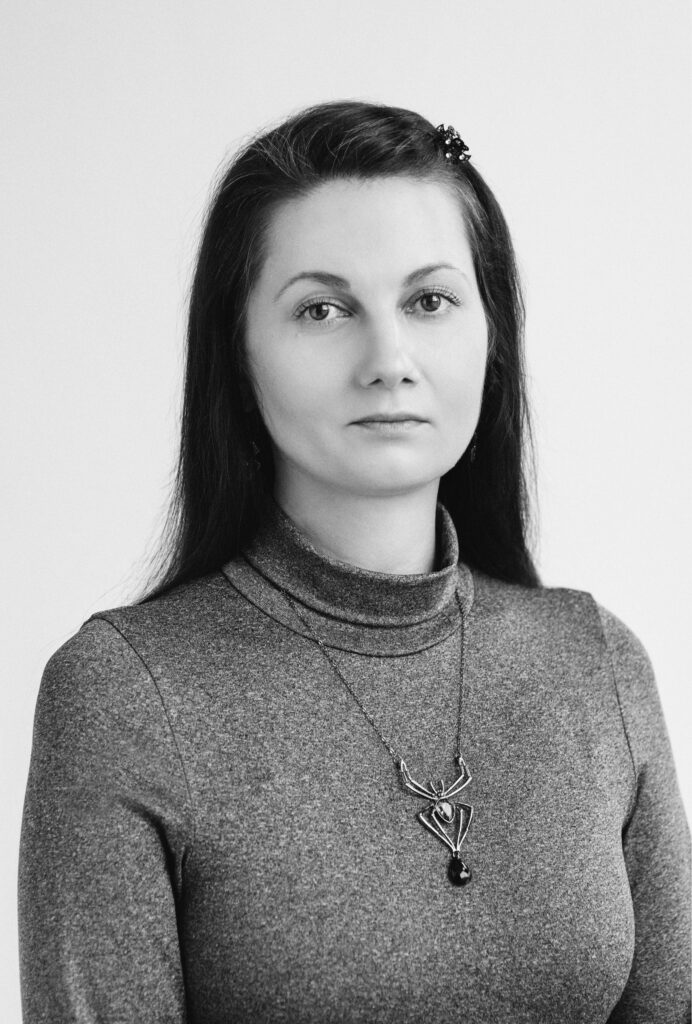
City: Luhansk.
January 2022. Answers provided in Russian.
1. What was your summer like in 2014? What prompted you to leave or stay?
The summer of 2014 was, without exaggeration, dynamic. I worked at a TV channel until June 26, and on the 27th, my husband and I hired a minibus, packed household appliances, took our dog, and headed to my mother’s place in the city of Teplogorsk, where it was relatively calm at that time. The city was occupied, but the battles for its liberation had not yet begun. And then, when they started in mid-August, my godmother insisted that we all needed to leave, and we did. It was clear that by September, the hostilities wouldn’t end. There was no guarantee that Luhansk would be liberated, and my child could go to school. So, my husband, son, and I ended up in a small village in the Khmelnytskyi region with my mother’s cousins. There, my son started going to school. In mid-September, we moved to the Kyiv region.
2. Is there a story of yours or your close ones that you would like to share? What struck you the most?
On June 2, 2014, my husband and I woke up to gunfire. It was clear—border guards were being stormed. And if they didn’t hold out, there would be no Ukrainian law enforcement organization left in the city—and that’s what happened. Many of my colleagues lived near the Luhansk border guard unit. I called the director, but couldn’t get through. Someone from the locals took a risk and tried to leave, while someone lived close to the combat area and couldn’t even look out the window. That day, after lunch, there was an explosion or shelling near the regional state administration building (Ukrainian law enforcement structures still haven’t explained what happened, and the militants have their own version—claiming the administration building was shelled by a Ukrainian plane). Eight people died. It was at that moment, in the backyard of the TV company, that I was shooting a story on how to provide first aid. Among the dead near the administration building was the husband of one of the persons featured in the story.
3. How did the year 2014 change your life?
I moved to another city and started a new life from zero, so to speak.
4. If you had the chance to go back to 2014, would you do something differently? If yes, what specifically?
I should have worked more and gathered information for myself. I think that’s my main mistake. However, I was constantly drawn back home, no matter where I was. And when I came home, I hardly read the news. When we moved to my mom’s for a month, I tried to keep up with the news, but the internet was terrible, and I could find out very little. In the evenings, we watched the news on the “Inter” channel. It was the only Ukrainian channel we could catch in our city. The journalists became like family to me. And I was very concerned that they were reporting from safe places.
5. How do you feel about your life now? Do you have any regrets?
Overall, everything turned out well. And everyone has their own problems. Do I regret anything? I try not to engage in self-pity.
6. Do you plan your future? If yes, for what term?
Certainly, I make plans. But in a general sense. And after 2014, it’s easier for me to cope with failure. Although even before the war, I didn’t worry too much if something didn’t go according to plan. The main thing is that mistakes and deviations from the intended path don’t cost anyone’s life. And everything else will somehow work out.
January 2024. Answers provided in Ukrainian.
1. On February 24, 2022, a full-scale invasion of Ukraine by Russia began. What was this day like for you? What were your feelings, and how did you react?
On the morning of February 24th, I went to work. Explosions were echoing in Kyiv, queues formed at gas stations. ATMs weren’t working. I managed to withdraw only 3000 hryvnias (editor’s note – approximately 80 euros). I hurried to the centre to buy food and alcohol before the start of the workday – it was clear that alcohol might be needed to calm down a bit (I wasn’t taking tranquillisers at that time). I felt that I was getting sick. I had a fever, so I can’t say I remember that day well. But I did buy brandy. I bought it and forgot it at work. It waited for me until I returned to the office in the summer.
3. What motivated you to stay in Ukraine? How were these two years of full-scale Russian invasion in Ukraine for you? What is your current emotional state?
On March 6th, my family and I moved to Vinnytsia. We rented an apartment there, and after the liberation of the Kyiv region, we returned to the city. During this time, I gained experience in conducting live radio broadcasts from the apartment. I also liked Vinnytsia. My godfather lived nearby, and we often strolled around, spending time interestingly. I couldn’t travel abroad with my husband and son, because both of them were conscripted, and they had no reason to leave the country. Besides, we didn’t consider such an option even theoretically. We wanted to return to Kyiv.
4. What changes and transformations have occurred with you (if any) as a person during these two years of full-scale invasion?
Yes, changes have occurred. I can conduct live broadcasts without preparation, from the apartment. The same goes for the news. I have become much bolder in communicating with people and won’t hesitate to tell someone off if they say inappropriate things.
5. If you could go back to 2014, would you do anything differently?
It’s easy to think when you know how events unfolded. I’ll put it this way: my mistake in 2014 was that I thought Russians were people. I searched for meaning in their actions and words. It was unnecessary on my part. I should have been creating a reliable community resisting the occupiers in Luhansk. At the very least. At most, across all of Ukraine, because agents still live in Kyiv and other populated areas.
6. Do you plan your future? If yes, for what term? How do you envision the future of Ukraine?
I do not plan the future, but I determine what I want and how to achieve it. For example, I want to expose collaborators all over the world. And also their wives and children. Therefore, they understand that trouble or a Molotov cocktail is waiting for them around the corner. It’s a game)))
The audio format of the stories will be available on the Unveiled Ukraine YouTube channel.