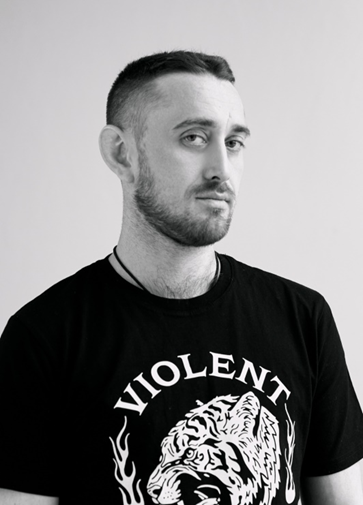
Donetsk city.
January 2022. Answers provided in Russian.
1. What was your summer like in 2014? What prompted you to leave or stay?
Everything began in the spring of 2014. My family had recently opened our own business (a small cafe), we had just started working when the so-called “referendum” took place. The city was blocked with checkpoints, barricades were erected, and protests were held, etc. Our cafe was located near the Donetsk Military Lyceum, and opposite it there was a military unit.
Sometime in early May, we heard gunfire in that area and thought it was just training, but it turned out to be worse. These were signs of future disaster. A week later, while returning from work, we saw a checkpoint at the entrance to our building. It turned out that one of the well-known Donetsk battalions had settled in the former children’s hospital building, and it was just five hundred metres from our house. We lived in the private sector of the Kyivskyi district, about ten kilometres from the airport. The city was living in constant tension, and the future development of events was unclear. From the end of May, the airport began to be bombed, and planes circled overhead to deliver the next strike – directly above our house.
In June, my acquaintances began leaving the city, and we decided to leave as well. At that time, the government was saying on television that everything would last only a few months, and for some reason we believed it.
At the end of June, we took a day off. It was early – around four or five in the morning. I woke up from gunfire near the house. Automatic bursts were getting closer and closer. Most likely, soldiers were looking for someone. It was hard to imagine that they were just shooting and walking around the yards. At one moment, I saw a person with a gun and in balaclava outside the bedroom window. I heard the front door open, footsteps – first in the kitchen, then in the hallway. The only thing separating us was the bedroom door. On one side, I was with my sleeping wife; on the other – someone ready to act at any sound.
Adrenaline was pounding in my ears. I had only one thought: “Let the child not wake up now, or it won’t end well.” I have never breathed so quietly in my life.
Eventually, everything ended without tragedy. The person stood there for a while, then, not getting what he wanted, left. He went back to the kitchen, looked into the fridge, and left the house. I lay still for another five minutes, then went outside and found our shepherd dog huddled in her kennel, too frightened to move.
Around that time, the future godfather of my child asked me for shelter. He lived in Ploshchadka – a microdistrict of the Kuibyshevskyi district. That was when shelling started there, as a new bus station “Zakhidny” had been built for Euro 2012. Compared to that area, it was calmer where we were.
At the end of June, we left for Crimea, which had already been annexed at that time. We stood at the customs for twelve hours and finally reached our destination. We stayed there for two weeks and started getting ready to go back home. We only reached the Dnipropetrovsk region when my mother-in-law called and said there was nothing for us to do at home. Fortunately, my wife Zhenya’s grandmother lived there, so we stayed with her. That was the beginning of waiting for the unknown. There was no work in the village, and our money was quickly running out. Three days after arriving, my former classmate — who worked in construction and lived in Feodosia — called me. He wanted to offer me a job, but said we needed to wait until a project appeared. Two weeks later, he called back.
During this time, I was beaten several times by the locals. The reason was that my car had Donetsk plates, and I spoke proper Ukrainian. Later, it turned out that they had mistaken me for someone else, but the fact remained. And here it was – salvation! I said I wouldn’t go without my wife. So, the two of us set off.
In Feodosia, I worked in construction, and Zhenya took care of my classmate’s children. Time passed until Zhenya was offered a job in Kyiv. She left in October. I completed the last project, thanked my friend for help and shelter, and in early December went to Kharkiv. There, I had to pick up my father and drive home to Donetsk.
In a few days in Kharkiv, local “artists” managed to vandalised my car – they wrote that I was a terrorist and that the car was a bomb, and they deflated the tyres. On the way back with my father, we got into an accident and got stuck in Kharkiv for another two weeks. But that’s another story about car service and people’s ability to earn. We made it from Donetsk without any special events and adventures, only at one checkpoint, they threatened to shoot us next time if we came with headlights on. However, on the way from Donetsk to Kyiv, I was offered weapons, drugs, and currency. At each checkpoint in the so-called “DNR” territory, I was stopped for document checks and to clarify the reason for visiting Ukraine because the car had Donetsk plates. Every time, during the inspection, they dismantled the car almost down to the last screw.
Before New Year, I arrived in Kyiv. After the holidays, I started looking for a job. I searched for nine months, going through regular interviews, group interviews, multi-stage interviews, but when it came to paperwork, everything fell apart. The Donetsk registration in my passport, like stigmatising mark, prevented me from moving forward.
2. Is there a story of yours or your close ones that you would like to share? What struck you the most?
In the summer of 2015, I was “accused of terrorism and recruiting people for terrorist organisations.” This is how it happened: my wife and I were sitting in a cafe, and I was talking on the phone with a friend who stayed in Donetsk. He was planning to get a job at the Donetsk pre-trial detention centre. We discussed the medical examination and other details of joining law enforcement. There was a couple sitting at the next table, about fifteen years older than us. They overheard some phrases taken out of context, such as “pass a medical examination” and “get a uniform.” They called the police.
A young woman and a young man arrived, asked me to finish the conversation, and told go with them. I asked them to specify the reason for their visit – and here I was shocked!
“You are suspected of aiding terrorism and recruiting people for terrorist organisations. Show your documents.”
My wife started crying, and when the policewoman found out where we were from, the situation changed. The young lieutenant took Zhenya aside and tried to calm her down, while I remained in the cafe with the second member of the police crew.
“Do I look like a terrorist?”
“I don’t know; I’ve never seen them.”
“Who called you?”
“That couple at the next table.”
We talked to this couple and found out that they simply misunderstood us. I don’t blame them – people were vigilant – but drawing conclusions based on snippets of phrases is wrong.
Things calmed down after some time, and I found my first job. Seven years have passed since then. During this time, my car was dismantled by some “inventors” twice, once almost in the yard of the district police department – it was about a hundred and fifty metres away. I filed reports twice, but there were no results. The second time, the patrol did not even come to inspect the crime scene. I don’t know what this is connected with, but I want to believe it’s not about my birthplace (editor’s note – The vehicle had Donetsk plates).
3. How did the year 2014 change your life?
The year 2014 dramatically changed my life. There were long-term plans for the future and ideas for further development, and everything collapsed in one moment. I had to radically change my entire life path and practically start all over again. The events of those years revealed many relationships between people. Friendships grew stronger, while some people simply disappeared from the horizon of communication.
4. If you had the chance to go back to 2014, would you do something differently? If yes, what specifically?
If I were to go back to that time, I would do the same. The children were very young, and they didn’t need to live in the conditions of war, witness all these events, and experience all these negative emotions. I do not regret those decisions for a second.
5. How do you feel about your life now? Do you have any regrets?
Now I am an ordinary employee of a company. In reality, I am very sorry that life turned out this way. However, the events that have occurred in my life have made me more resilient, but also tougher.
6. Do you plan your future? If yes, for what term?
The desire to plan for the long term exists, but as long as there is no stability and financial independence, there is no planning.
January 2024. Answers provided in Ukrainian.
1. On February 24, 2022, a full-scale invasion of Ukraine by Russia began. What was this day like for you? What were your feelings, and how did you react?
On February 24, my morning started around five. My uncle from Kharkiv called me, saying, “It’s started, the war has begun!” Somewhere in the distance, I heard the long-forgotten sounds of shell explosions. The only thought echoing in my head was, “Again? Really?” A little later, the whole family woke up. We taped the windows with tape, as we had done in Donetsk, and just in case covered them with curtains for some protection against glass fragments. At the time of the invasion, my younger daughter was six years old, and she made a bunker for herself in the closet, building LEGO guns for the Armed Forces of Ukraine.
3. What motivated you to stay in Ukraine? How were these two years of full-scale Russian invasion in Ukraine for you? What is your current emotional state?
When the question of leaving Kyiv or the country arose (editor’s note – Dmytro’s family had the legal right to go abroad, because they have three children), we decided to stay. “We’ve already fled from the war once, and it found us again. So we will face it here, overcome it, and then live in our own free country.” This was the decision made in the first days of the war.
In the first few days, products disappeared from the shopes, so my mornings began with searching the entire neighbourhood for any store where I could buy something. Each time, I had to stand in long queues, usually in vain. During those moments, I stayed in constant with my wife because artillery and gunfire were taking place nearby. I needed to know that everything was fine with my family.
The company where I worked was not operating either, but they immediately paid us a month’s salary in advance, which helped us greatly at the very beginning.
4. What changes and transformations have occurred with you (if any) as a person during these two years of full-scale invasion?
Overall, I can say that nothing significant changed. I simply became sadder because of former friends who, since 2014, began to consider us nationalists and tried to prove that we all needed saving. Love for our Motherland is not Nazism or fascism, but not everyone understands that. Once again, the war revealed the true faces of people with whom we used to communicate.
5. If you could go back to 2014, would you do anything differently?
If I were to go back to that time, I would do the same.
6. Do you plan your future? If yes, for what term? How do you envision the future of Ukraine?
As for planning the future, I can say that, like in 2014-2015, I cannot plan for any extended period. After shells hit within 500-800 metres from our home, you understand that every day could be the last.
But the faith in our unbroken spirit, the Armed Forces of Ukraine, and air defence inspires belief that Ukraine will be free, independent, and a wonderful country – because extraordinary people live in it!
The audio format of the stories will be available on the Unveiled Ukraine YouTube channel.