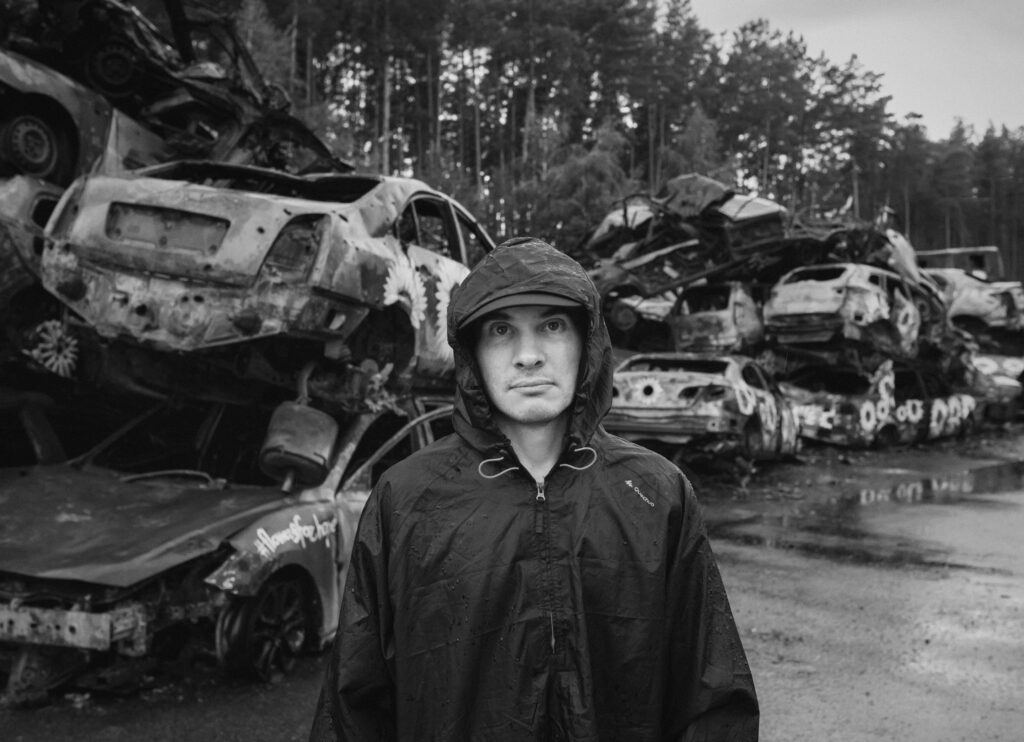
Andriy, 42 years old, manager.
Luhansk city.
All questions were asked in January 2024. Answers are provided in Ukrainian.
1. What was your summer like in 2014? What prompted you to leave or stay?
Summer 2014, I spent in Luhansk, my hometown, engrossed in work. Unaware of the dramatic events that would unfold soon. I was studying English and saving money for future trips that I dreamed about. Even then, I had firmly pro-Ukrainian views, shaped during my student years. I had friends in other cities of Ukraine. At the same time, I remained a Russian-speaking resident of Luhansk, understanding Ukrainian well, as we studied it from the second grade of elementary school. Therefore, when the boiling point was reached in early August 2014 and there was no possibility to stay in the city, I found out where the minibuses were heading towards Starobilsk, packed a suitcase with winter clothes, and, aware of the risks but without hesitation, set out on a journey with my mother to avoid returning. We reached Kharkiv, where we celebrated Independence Day on August 24, 2014. Next was the city of Dnipro. In the fall of 2014, for a while, railway communication with Luhansk was restored, and my mother decided to return. Our paths diverged, and I continued to Kyiv. At the end of November 2014, I was about to turn 33.
2. Is there a story of yours or your close ones that you would like to share? What struck you the most?
I have been and continue to be impressed by the stories of those adults who left the occupied territories and returned. They returned to a surreal world of blatant lies and post-Soviet and pro-moscowian propaganda, singing praises to a 20-kopeek ice cream cone. A world where banks and postal services don’t function, where there’s no mobile internet, no quality goods or services. A criminal world where might makes right.
I feel sorry for the children growing up there. Their mothers believe in the words that their children “won’t be taken to serve.” They fail to realise that it’s the blood of these children that they will pay with for taking those dirty moscowitskiy passports into their hands – passports that are considered second-rate even in Moscovia. Passports that only allow living and dying within their 30-kilometre exclusion zone.
3. How did the year 2014 change your life?
In October 2014, my new life began. It’s that joke where only fate is laughing. A conscious and responsible life. When only I determine how I will live, what I will eat, where I will sleep. I can’t say that this life is right, but there’s nothing to be ashamed of. Over these years, I managed to find new friends and keep the old ones. I hope I lived these years with dignity. After all, I am writing these lines at the end of January 2024, and, in my opinion, this proves that my life is not the worst possible.
4. If you had the chance to go back to 2014, would you do something differently? If yes, what specifically?
In my opinion, in 2014, I did everything right. Yes, I could have left a bit earlier, a bit safer. However, it happened at a moment when there was no other alternative, and I am grateful to all the people, friends, acquaintances, colleagues, who were there for me at that time. It’s regrettable that my mother made the decision to return to Luhansk. Even more regrettable that she doesn’t realise it and doesn’t want to leave from there.
5. How do you feel about your life now? Do you have any regrets?
The events that occurred in 2014 confirmed a simple truth: “Don’t have 100 banknotes, but have 100 friends.” I am grateful for the help I received at times from ordinary people and sometimes from acquaintances who had every right to stay aside but helped as much as they could. Later, I tried to repay fate by helping others when the opportunity arose. Another wisdom proved true: “When you’re feeling down, find someone who’s worse off and help them.” It’s true.
6. Do you plan your future? If yes, for what term?
All the plans for the new life after 2014 were ruined by the invasion of the Moskovitskaya horde in 2022. More on this below.
Questions of January 2024:
1. On February 24, 2022, a full-scale invasion of Ukraine by Russia began. What was this day like for you? What were your feelings, and how did you react?
On February 24, 2022, my experience began in the town of Nemishayevo, about 30 km west of Kyiv. I lived there in a small house and commuted to Kyiv for work by train every day. In the morning, I received a message from friends advising not to travel to Kyiv that day, but I decided to go anyway. Around 7 a.m., I went to the suburban train station and waited for about an hour. An announcement was made that the suburban train service to Kyiv had been suspended. So, on that day, February 24, 2022, I found myself in the places where the most tragic events of the defence of Kyiv unfolded in the spring of 2022. Nemishayevo is located between the now sadly famous towns of Irpin, Bucha, and Borodyanka. In the first few days, there was still communication, electricity, and gas. It was clear that the war had begun, and any attempt to move from the town towards Kyiv or to the west, towards the Zhytomyr highway, was deadly dangerous. Therefore, I decided to stay in the town until the first opportunity to leave relatively safely.
Unlike the locals, who often could not believe what they saw with their own eyes because “this cannot be,” I already had personal experience escaping with a suitcase from the war in the summer of 2014 and had seen the burning fields of Luhansk. Gradually, communication, electricity, and natural gas disappeared. On March 9, people began to cook food on open fires. The civilised life of the past decades led to the fact that even in old houses with stove heating, the stoves had been dismantled. Subconsciously, people were not prepared and did not prepare for such a surge.
The smartphone batteries were running out. The locals found solace in a local shelter where residents of several nearby streets could hide, communicate, recharge their phones, and flashlights. Local volunteers provided food to those who needed it and took care of the sick and the elderly. A generator, activated for two hours each day for recharging, became a real miracle. Approximately from March 10 to 15, a “green corridor” and the evacuation of civilians were announced. The only way for men to leave was behind the wheel of their own cars, where their wives and children were. Many of these cars remained on the sidelines of the Zhytomyr and Warsaw highways, shot by the occupiers. Eyewitnesses told horrifying stories. After the evacuation, the town emptied. Nemishayevo was spared the fate of Irpin, Bucha, and Borodyanka. Fortunately, the occupiers did not enter the houses or check documents. Perhaps they didn’t have time. I didn’t have to encounter any occupiers face to face, so I preserved my life and health and have the opportunity to write these lines. Yes, there were wounded and killed among the local residents. Volunteers, ordinary guys and girls looking for groceries, medicines, fuel for the generator, and firewood for stoves, took the most risks. They distributed food to bedridden patients who couldn’t make it to the shelter on their own.
We first saw Ukrainian Armed Forces scouts on April 1, 2022. We welcomed them with applause and great gratitude for the liberation. On April 9, 2022, I went to work in Kyiv for the first time. We travelled for several hours by car through traffic jams, passing volunteers, special equipment, wrecked civilian cars on the sidelines, and burnt armoured vehicles of the occupiers. We bypassed the blown-up bridges over the Irpin and Bucha rivers on the outskirts.
That was my day on February 24, 2022.
3. What motivated you to stay in Ukraine? How were these two years of full-scale Russian invasion in Ukraine for you? What is your current emotional state?
Formally, I do not have the right to leave Ukraine during the state of war, and I have no desire to do so. These two years, I have been in the city of Kyiv. In the first few months, the spring and summer of 2022 were inspiring due to the extraordinary unity of the people. At that time, my means of transportation was a bicycle, which proved to be quite sufficient. Later, people began to return. The events of the Kharkiv counteroffensive and the liberation of Kherson and the right-bank part of Kherson Oblast were met with great inspiration. The blackout period of the winter of 2022/2023 was a challenging time.
The year 2023 turned out to be morally more challenging. In September 2023, I visited acquaintances in Kharkiv, who were the first to welcome me with my mother when we fled from Luhansk in the summer of 2014. I saw educational classes in the Kharkiv metro. This was the only trip beyond the Kyiv region in these two years. There were informational provocations from the enemy and unclear actions of local authorities. Constant gatherings of volunteers amid the reinstallation of pavement, both literally and figuratively. It truly shakes one’s consciousness, and there is an understanding that efforts need to be focused on fighting the external enemy. The President of Ukraine as the Supreme Commander-in-Chief and the Commander-in-Chief of the Armed Forces of Ukraine are indisputable leaders of the state, doing everything possible to preserve Ukraine’s territorial integrity and sovereignty. Huge thanks to Western partners, European countries, the United States, and the world for providing military, humanitarian, and economic support to Ukraine, without which it would be impossible to resist the onslaught of the Moscow horde. Glory to Ukraine! Glory to the Volunteers! God Bless America! Long live the King!
4. What changes and transformations have occurred with you (if any) as a person during these two years of full-scale invasion?
Ukraine is Europe.
I have definitively switched to the Ukrainian language, the language of the state of which I have been a citizen since birth. The realisation of the hostility of the Soviet legacy and the Muscovite reality. The exclusion of Moscovit’s narratives from my personal information space, including the so-called culture and everything else that currently evokes disgust. Communication with those acquaintances and relatives who remained on the other side of the “porebrik” (A slang term for Russia, based on the St. Petersburg dialect, in which the word “bordyur,” meaning the border on the sidewalk, is replaced with “porebryk.” This term is often used in Ukraine in a playful or ironic way to refer to Russia, highlighting linguistic and cultural differences. – Author’s note.) has almost ceased. Mostly because they do not consider the aggressive war unleashed by the so-called Russia a crime. They are afraid to admit it to themselves. People who have left the occupied territories for Moscow, in my opinion, are much more open. They made their choice.
5. If you could go back to 2014, would you do anything differently?
I’ve already written about 2014 above. Here are a few words about what I did after 2022. Yes, I understand that future events will unfold differently, and some of my warnings may turn out to be futile. However, now I have a huge 50-litre gas cylinder with liquefied gas and a canister of fuel. This is a currency that is hard to overestimate when life is slipping out of control, and you need to escape or survive against all odds.
I understand that it’s necessary to raise funds for armour and military equipment. It’s necessary to undergo training in tactical medicine and learn to operate drones. It’s worth doing all of this right now.
6. Do you plan your future? If yes, for what term? How do you envision the future of Ukraine?
My planning period extends until “the 25th of the next month” – the deadline for depositing funds into your credit card to maintain the favourable period of the revolving credit line. I understand the need to have a “financial safety net” for at least a few months in case of anything. I dream of having a car and my own home. I dream of owning a registered firearm. I can’t be candid with myself because any plans don’t make sense as long as the war continues.
Ukraine awaits a victorious future. The next generations of Ukrainians will see it, and they won’t have any doubts about who the real enemies are and who the friends of Ukraine are. Ukrainians, who will remember alarms and rockets from childhood, who are currently studying in underground classrooms, who will receive a fully automatic rifle as a gift for their adulthood and will understand how to handle it and why it’s necessary. It’s worth living for this.
The audio format of the stories will be available on the Unveiled Ukraine YouTube channel.