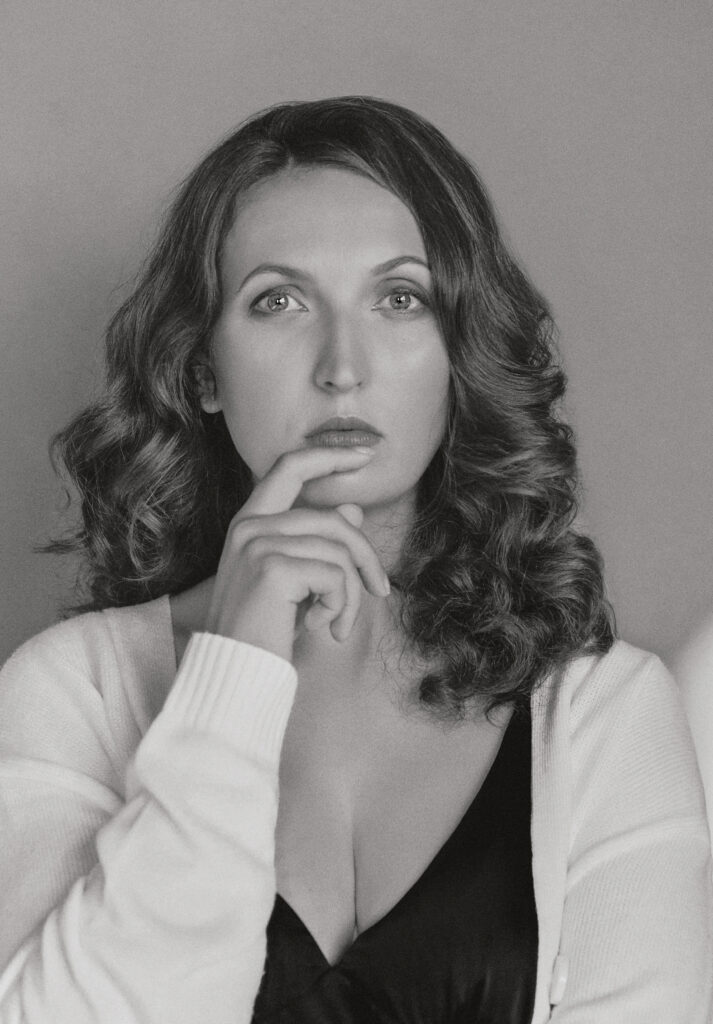
City: Luhansk
September 2024. Answers provided in Ukrainian.
1. What was your summer like in 2014? What prompted you to leave or stay?
My summer of 2014 was quite challenging because that was when the war began. Fighting broke out in Luhansk, with administrative buildings being seized and the city occupied, forcing us to leave.
In May 2014, my husband was captured in Luhansk. He was detained by local collaborators as a pro-Ukrainian activist. They took him to the seized SBU building, where he was mocked, interrogated, beaten, and tortured. We had planned our wedding for June 7, 2014, in Luhansk. But because of his captivity, the torture, the threat to our lives as pro-Ukrainian activists, and the outbreak of hostilities, we had to cancel it and flee to the city of Dnipro.
In Dnipro, we gave an interview, and a journalist reached out to the local authorities. They helped and organized a civil ceremony at the Babushkinsky district registry office. It was a very colorful, small wedding in Ukrainian style, with embroidered shirts (traditional Ukrainian attire, usually handmade). Such wedding styles are very popular now, but back then, it was rare. A special symbol for us was my embroidered Ukrainian dress, which I brought from Luhansk and was deeply worried that the separatists might find it.
That summer, I returned to Luhansk alone (my husband was on an execution list and couldn’t come with me). I had a job there, my mother, and property. I stayed in Luhansk for two weeks (though I had planned to stay longer), but there was a great threat to my life when I found out that we were being searched for (they thought my husband had also returned). I had to pack within two hours and leave Luhansk forever with just one backpack.
At that time, we started a volunteer movement that later registered as the charitable foundation “East SOS.” I was searching for housing opportunities for refugees. We moved to Kyiv, and the second half of the summer was filled with very active volunteering because so many people were calling our hotlines and asking for help (to leave, find shelter, and requesting medicine or humanitarian needs). With this hectic schedule, we also had to meet our own needs: finding housing in a new city and adapting. But we spent nearly all our time at the foundation, returning home at half past eleven on the last metro train. And this was every day, without weekends.
In the fall, when it got colder and started to rain, I realized I was still wearing summer sandals and light clothing… A friend brought me sneakers.
2. Is there a story of yours or your close ones that you would like to share? What struck you the most?
I want to share the story of our friends, an active group of like-minded people called the “Civil Sector of Euromaidan Luhansk,” who held peaceful actions (rallies, peaceful demonstrations, etc.) in Luhansk in the winter and spring of 2013-2014 in support of Ukraine’s European integration, against corruption, against Yanukovych, and in the fight for human rights and European values. I also participated in these actions. Unlike the protesters in Kyiv, we were not shot at, but the local authorities strongly opposed us, and anti-Maidan and pro-Russian collaborators held counter-protests.
On March 9, the birthday of Taras Shevchenko, when we came out for a pro-Ukrainian rally, pro-Russian forces appeared across from us. They were much more numerous, as some of them had been brought in from Belgorod by buses. There were many aggressive people—so-called “titushky” (paid provocateurs).
I want to emphasize that there was a significant movement in Luhansk resisting the pro-Russian authorities. This movement organized peaceful, cultural actions, which, unfortunately, turned out to be very naive because peaceful actions are powerless against tanks or guns. By the spring of 2014, staying in Luhansk had become very dangerous: we were being watched, threatened, pressured, beaten, captured, and intimidated, so we all began to leave. But it is crucial to remember that there were and still are many pro-Ukrainian people in Luhansk.
3. How did the year 2014 change your life?
The year 2014 radically changed my life. Before 2014, I was a tourist, engaged in sports, worked as a methodologist at the Luhansk Regional Center of Tourism and Local History, led archaeology clubs, worked with children, taught, guided expeditions and hikes, climbed rocks, and lived my happy young life. In 2013-2014, I was fighting first for Ukraine’s European integration path, and then began my work with victims, volunteering, and my fight in the war. I had to quit my old job in Luhansk, leave the city, and completely change my life. My happy life ended then because this war has been going on for 10 years, and the carefree, happy life still hasn’t returned.
Russia had been preparing for this for a long time, and for 10 years since the invasion began, they have been committing terrible things in Ukraine.
4. If you had the chance to go back to 2014, would you do something differently? If yes, what specifically?
Oh, yes! If I could go back to 2014 or 2013, my actions would be completely different. My colleagues, husband, friends, and I participated in the Euromaydan in Luhansk, were activists, pro-Ukrainian, and tried to influence the situation peacefully. But as practice shows, soft, peaceful methods do not work and have no impact on the actions of the aggressor, the abuser — the vast country of Russia, which had terrible plans: to occupy territories, kill people… by any means necessary. Only forceful methods can stop them. Our peaceful protests were quite naive, and now I understand that at that time, the situation could only be influenced and changed by forceful means. If we had been tougher, smarter, and more decisive back then, perhaps all these terrible events would not have happened later.
5. How do you feel about your life now? Do you have any regrets?
The war continues, and of course, I don’t feel very happy because it’s very hard to live in war: constant tragedies around, a battle of attrition, and I have to work a lot. My job is related to helping civilian victims, and I also volunteer to help the military. I have two young children, my husband is in the military, and many of my friends are either soldiers or help by constantly traveling to frontline areas to evacuate people. Every night, Kyiv is under attack: explosions and strikes can be heard. I was especially struck by the hit on the Okhmatdyt hospital, which is located near me. I fear for the lives of my children, for my own, because I don’t know who will take care of them, who will love them if something happens to me?
There were several moments when my husband could have died on the front lines. He survived, but it is all very hard. I regret that we were too soft dreamers and did not fiercely oppose Russian aggression and everything Russian to protect ourselves.
But I stay here because, despite everything, Ukraine is a beautiful country with wonderful, strong people, a rich nation in every sense of the word, with cultural and historical heritage, and beautiful nature. I am working for the future of this country. If you are reading this, I warmly invite you to visit and see Ukraine with your own eyes.
1. On February 24, 2022, a full-scale invasion of Ukraine by Russia began. What was this day like for you? What were your feelings, and how did you react?
On February 24, 2022, we woke up, like the entire country, at five in the morning. Our child was 8 months old at the time, and he didn’t cry; he just looked out the window with an adult-like gaze, as if he understood something was wrong. My husband went to check and told me that the war had begun. We acted according to our plan. This wasn’t our first experience with war; we had felt it since 2014. This time, we were prepared. Two years earlier, my husband had joined the Territorial Defense Forces of the Solomianskyi district of Kyiv, the 130th battalion, and he had been training for two years, equipped with all the necessary military gear. We had a plan: if a large-scale war broke out, I would rescue our family, take the child and our relatives to safety, and my husband would go to the front line. And that’s exactly what we did.
We had an agreement with a friend that he would pick us up by car. And that’s what happened. He came with his wife and a friend, picked me up with our baby and my mother along with our things, and we headed west of the capital. We left around 9 a.m. Most people were stuck in traffic jams on the Odesa and Zhytomyr highways. My husband had planned the route and advised us to leave via the north, which allowed us to pass safely. After that, intense fighting and the occupation of the region began—horrific events. We arrived in Rivne, where we waited a long time at the train station and had a difficult journey, but we were heading to Slovakia to our relatives. We were on the road for two days, and I didn’t sleep for two days, holding the baby in my arms, standing in line at the border at night, with the baby running a fever close to 40 degrees Celsius. I was terrified for my husband because I didn’t know what was happening to him. We also had two cats with us, which made it even more challenging.
2. Were you forced to leave Ukraine (perhaps temporarily)? If not, proceed to the next question. If yes, share your experience abroad: were you in one country the whole time, did you move to several countries, did you have to learn a new language, adapt to a new profession, etc.? Where are you now? Do you plan to return to Ukraine when the military actions end?
Leaving Ukraine was a spontaneous decision. At that time, we were heading towards Rivne. I wondered where we would stop, where we would sleep with an eight-month-old baby in our arms. We needed a place to wash and feed him. I decided to go directly to my husband’s mother’s place in Košice, Slovakia. I wrote to her, and she replied, “Of course, come.” That’s how I decided to go abroad. We traveled for two days: the train was overcrowded and moved very slowly because the trains were also being shelled and people were evacuating in large numbers. Each shelf was occupied by three people. At the border, we were among moms, pregnant women, with babies, children, and toddlers. It was a complete nightmare.
Arriving in Slovakia, in Košice, everything was just beginning because in Ukraine there was a full-scale war, and my husband was in unknown circumstances. It was terrifying. At one point, my husband and his comrades asked me to raise money for a thermal drone that cost 6,000 euros. This was a huge amount for me! 6,000 euros, wow! The amount seemed overwhelming. But I started collecting money, and that’s how my new activity – volunteering – began.
My mother, my son, and I lived in Košice and in a guesthouse near Košice, which had been designated for Ukrainian refugees. We lived there for a year, and after a year, I decided to return to Ukraine. During that year, I often traveled to Ukraine, but not to Kyiv, rather to Transcarpathia, to Uzhhorod. Then I went to Kyiv and realized that, in principle, I could return. It was more important for me to live and work in Ukraine than in another country. Over the year, many things happened: I became a real volunteer. I continued to work. My work, for the past 8 years, now 10, has always been related to helping those affected by the war through the charity foundation “S’hid SOS.” But I also continued to volunteer: we provided assistance to educators, representatives of civil society, and supported educational activities. With the full-scale invasion, the work increased even more.
Volunteering also became larger in scale. At first, I was raising 6,000 euros for a thermal drone, but then it became much broader. I ended up buying military trucks from Denmark or vehicles from Lithuania, Poland. For me, 6,000 euros was no longer a large sum because the trucks cost 15,000 to 18,000 euros, and the cars a few thousand. At that time, we bought about 5 trucks, many cars, a bunch of drones, thermal cameras, gear, and bulletproof vests. It was an interesting experience.
Living in another country with a different currency and language, I learned to purchase through online services in various countries, such as Germany, and figured out their deliveries, websites, and currency conversions. It was an exciting experience.
3. What motivated you to stay in Ukraine? How were these two years of full-scale Russian invasion in Ukraine for you? What is your current emotional state?
I returned to Ukraine a year after the full-scale invasion — consciously and with a strong desire to do so. My husband wasn’t initially thrilled about the idea, as we returned to Kyiv with our child, where shelling was constant, and sometimes up to 100 rockets would fly. But I took into account both the security situation and the moral one. And we came back.
What has changed? Over these two years, I’ve gained very serious, diverse experience. I became a volunteer, learned to raise funds, gather and use them to purchase aid, and transport all of it — I even got behind the wheel and started transporting drones, thermal imagers, and other necessary items across the border. I also gained new experience — being the wife of a soldier. It’s very scary and emotional. My husband was in hot spots: Irpin, Kharkiv region, Luhansk region. He served both in infantry and in a UAV unit, not in rear positions but on the front lines. You’re constantly worried about him and the child.
When your husband is not around, and he can’t handle household matters or make decisions about the child and family, you have to step into his shoes, handle everything on your own, and at the same time support him during the war. And, of course, these two years, I’ve been working, volunteering, and sometimes running to the shelter with my child in my arms during regular shelling. Russia is shelling Kyiv and all of Ukraine, and air defence systems are operating. It’s terrifying when you’re sitting, holding your child, and I was pregnant — I now have my second child. Pregnant, with my first child in my arms, sitting there while a “Kinzhal” missile or a “Shahed” kamikaze drone flies over the house. That’s the kind of experience I’ve had.
4. What changes and transformations have occurred with you (if any) as a person during these two years of full-scale invasion?
In these 2.5 years, there have been significant changes – the experience I’ve gained since the start of the full-scale invasion is something I didn’t have even in 2014, despite working on the front line for 8 years and seeing a lot. But this stage of the war is much more terrifying, horrible, with a multitude of unexpected problems that need to be addressed, which I hadn’t anticipated at all. Over the years of the full-scale war, we’ve become stronger, more multifunctional, and the scale of volunteering has changed – I estimated that in 2.5 years, I raised approximately 309 thousand euros, which were used to purchase many things for the military and to organize logistics. I also had another child; I now have two sons… with my husband, of course. He was at war and came home rarely. We hadn’t planned for another child, but during one of his visits, it happened that we had another baby, and it’s wonderful! My professional activity has also expanded, as many people need help, and my job is to provide that help.
6. Do you plan your future? If yes, for what term? How do you envision the future of Ukraine?
I really want to plan for the future, dreams come to mind, but then common sense reminds me that it’s not so simple. It seems to me that we will have to fight for a long time yet, and such a critical, crisis situation will last for several years, so we need to plan our actions considering these difficult circumstances. There will be no easy and quick victory, and we need to work hard so that at least our children have a peaceful life in the future, and perhaps even our grandchildren.
I have two young children, and I’m very afraid that they will have to fight when they grow up, and I really don’t want that. This is the future I see right now, and I am doing everything I can to ensure that they don’t have to fight, that they have the chance to choose peaceful professions, to be artists, teachers, IT specialists, whatever they want, but not soldiers. That is what I truly wish. My husband says that our little Cossack will be a soldier. We’ll see. But I sincerely hope that they won’t have to fight.
Regarding the near future, in terms of daily life, I plan only for the short term. I try to give my children a childhood because, war or not, childhood is unique and cannot be returned. Their future mental health depends on what I provide for them now (along with their father), so all my plans are focused on giving them a happy childhood, and that’s it.
The future of Ukraine is living next to a dangerous neighbor. I see us as a strong country, but we must always take into account the danger from Russia and prepare for it. We have chances for victory, but it won’t happen right away. I believe the future will be good, but a lot depends on us. We will always live, as we did 300 years ago, considering that there is a great danger nearby.
The audio format of the stories will be available on the Unveiled Ukraine YouTube channel.