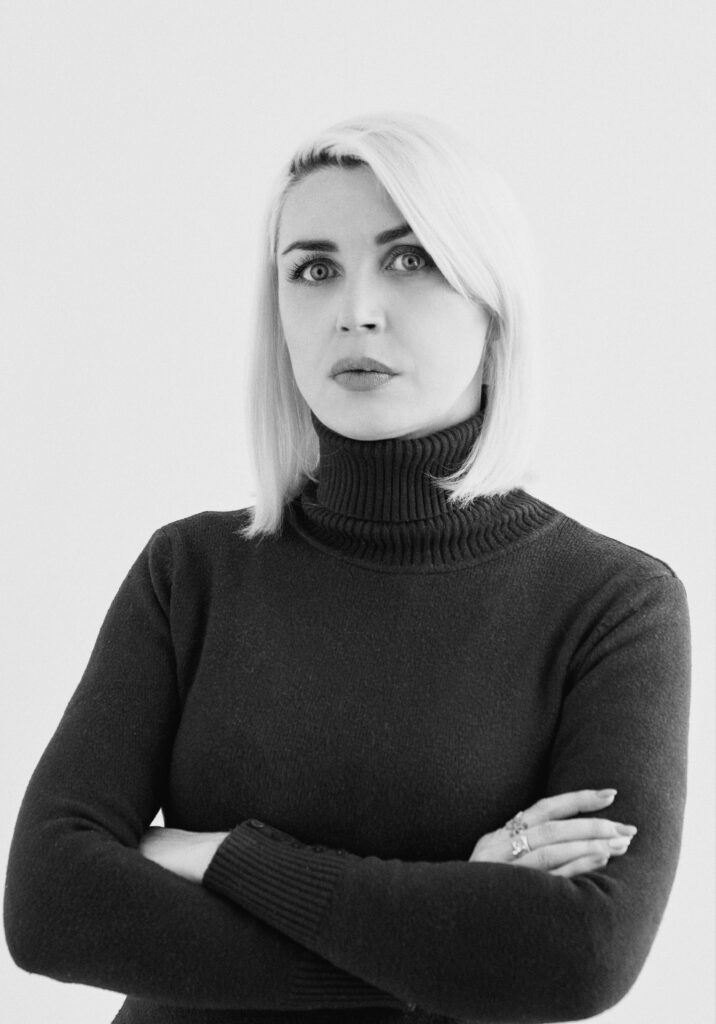
Luhansk city.
January 2022. Answers provided in Russian.
1. What was your summer like in 2014? What prompted you to leave or stay?
On May 31, 2014, I left Luhansk with my children. The situation in the city was challenging, and it was evident and felt everywhere. The decisive factor was the seizure of a large office building in my yard. They were bringing something there all night by car, and the decision to leave was made instantly. We thought we’d be gone for a week or two, but it turned out to be forever. In general, the summer of 2014 can be described with one phrase – significant stress. Constant calls from relatives, requests to leave there, advice on where to hide during shelling. I try not to dwell on it and move forward. But it’s not that simple.
2. Is there a story of yours or your close ones that you would like to share? What struck you the most?
My father, Andriy Vitaliyovych Pastukhov, a surgeon, stayed in Luhansk until the end of July 2014. Despite all pleas to leave, he responded, “I am a doctor, it’s my duty. I won’t go anywhere.” For two weeks, he lived in the hospital, treating and caring for the wounded from both sides (not without threats from occupiers) and was unwilling to leave. He personally witnessed tanks entering the city, how they shelled the Luhansk airport (editor’s note – where Ukrainian military was stationed at that time), using cannons located beneath his hospital. Life turned upside down and resembled war movies. Once my brother said that dad asked to convey: “If communication is lost, don’t look for me, don’t come, there is no need. Live your life and don’t worry. We’ve already lived ours.” After hearing these words, I had a hysterical reaction; I barely managed to call my dad on the city phone at the hospital and, in loud and explicit language, pleaded with him to leave everything and go. He disagreed, but after the MH17 incident, he changed his mind. He managed to buy a train ticket, wrote a leave request at work, barely made it home, packed his things, and went to the train station. At that time, the city came under shelling, and he decided, in his words, “I’ll go, if they kill me – so be it.” This sentence still fills me with horror and panic. I won’t talk about how things shouldn’t be in our world; those who start wars won’t hear it anyway. To this day, he doesn’t share details of those days. Fortunately, my father made it to the train, boarded it, and left, pierced by the new reality of Luhansk. In 2011, he participated in the first festival of amateur art of medical workers in Ukraine, representing Luhansk, and won 1st place in the “Author’s Song” category. In 2016, at the third festival in Ivano-Frankivsk, he performed for Cherkasy and again took 1st place in the same category. He had the honour to participate twice in the gala concerts of the “Songs Born in the ATO” festival (editor’s note – ATO means Ukrainian Anti-Terrorist Operation). The song “Letter to a Colleague” was composed spontaneously, recalling conversations in the hospital with young surgeons who were very afraid of NATO.
3. How did the year 2014 change your life?
Absolutely. On the one hand, losing everything that was yours and not having the opportunity to return anywhere is terrifying. On the other hand, we survived, and I had enough strength to rebuild life for myself and my children again. It’s wonderful that I have character and can overcome many difficulties – it’s truly possible. The main thing is to start! However, I would prefer to demonstrate my character not in situations of war, lack of money, lack of housing, and other episodes of a dreadful reality. But I’m glad I left Luhansk; otherwise, I might have been stuck there, turning into mud.
4. If you had the chance to go back to 2014, would you do something differently? If yes, what specifically?
If I had returned, at least in March 2014, I would have sold the apartment, gathered my things, and left as far as possible.
5. How do you feel about your life now? Do you have any regrets?
It angers me the most that the state is indifferent to internally displaced persons. It seems like they exist, but somewhere far away, and they will somehow manage on their own. None of the presidential candidates in their election speeches ever mentioned internally displaced persons. Almost after 8 years, they came up with something regarding our integration into society (as if we are some parasites, and there’s no escaping from this plague, let’s integrate them, let it be…). There is no proper housing program, people have to go back to the occupied territory, but nobody cares, they are called traitors and separatists. The state simply spits on its citizens, and it’s strange to me because parallel to such behaviour, there are endless speeches about being European, wanting to join the European Union. If you don’t value and cherish your own citizens, maybe first deal with that, and then dream about the European Union? In the city where I live, real help – food sets, clothes, holiday events, and gifts for a child starting school – is organised by the church. Not the Ukrainian Orthodox Church, but Christian communities (I don’t remember the exact name, sorry). Personally, for me, it’s a significant indicator of indifferent attitude. Ukrainian citizens in 2014 also showed themselves from the “wonderful” side. Not everyone! There were numerous people who helped, supported, but there were also many who raised housing prices, didn’t let displaced persons into their valuable rental apartments, insulted, and accused us personally of everything that happened. So sometimes, I wish these people to go through what we went through. Justice, you know.
6. Do you plan your future? If yes, for what term?
I don’t think about the future. At most, I plan for a month ahead. I always think about where I would run if the war starts again, what things I would take with me, and how to transport my cats. How my children will study in a new place. There is fear of being left without money. These fears and the stress they cause have undermined my health. I don’t think about the future, but I try to live positively. If I don’t dwell on everything that happened, don’t think about the possibility of it happening again easily, then, in principle, I can live. But most of all, I want to live, not just survive.
January 2024. Answers provided in Ukrainian.
1. On February 24, 2022, a full-scale invasion of Ukraine by Russia began. What was this day like for you? What were your feelings, and how did you react?
On February 24th, I woke up to explosions around 6:30 in the morning. At first, I thought it was thunder, as the weather had been very warm the day before, almost like spring. However, checking Telegram, I realised that the Russian invaders were not joking. Within half an hour, I managed to pack an emergency suitcase with medicines, food, documents, matches, knives – everything that might be needed. I filled containers with water and taped up all the windows. I called all my friends and relatives, most importantly, my child in Kyiv, before waking up my younger child (who was still sleeping). I told her, “Get up, we’re being bombed, the war has started.” She was very frightened, but I reassured her, made a bed for her in the bathroom, brought her the cats, and she sat there, still very anxious. I acted decisively, explaining to the children what to do in case of injury, how to calm down during a panic attack, how to hide, and how to get out from under debris. I wrote down the phone numbers of all my friends for my younger child and explained how to behave if I were killed. There were constant calls with advice and new information about the events. It was scary to go outside and we had everything, so we stayed at home. In the evening, when they went to sleep, I had a very serious panic attack. I didn’t have any specific medications, so I focused on breathing, drank water, and feared that my child would wake up and also be frightened. Perhaps there were other things, but I don’t remember. I remember my composure and the absence of fear. The fear only came at night.
3. What motivated you to stay in Ukraine? How were these two years of full-scale Russian invasion in Ukraine for you? What is your current emotional state?
What prompted me to stay in Ukraine was the understanding that I had already experienced starting life from scratch. The elder child categorically refused to leave, and the younger one as well. We did discuss the option of leaving, but we genuinely didn’t want to. I didn’t feel a fatal danger.
Looking at my friends who left, some adapted, while others are in a depressed state, wanting to return home to Ukraine but having nowhere to return to. The sense of time is very strange: sometimes it feels like only 2 days have passed, and sometimes it feels like 20 years. It feels like everything has been going on for 20 years already. I understand that for many, it only began in 2022 – for me, it started in 2014. Nevertheless, when I hear that 10 years have passed since 2014, it’s hard to believe, and it seems like I left just yesterday. All these years feel like a fog: you try to live and work, but there are some things you just can’t do.
For example, I used to love taking photos of nature, animals, and myself, but now I have no desire to do it. Especially taking selfies – can I really take selfies when guys are fighting, dying, and sitting in bunkers? I force myself to celebrate New Year’s – I have no desire for it. My younger child says, “What New Year? There’s a war in the country.” From 2022 to 2023, we celebrated the New Year a bit, even made a blue and yellow tree. But this year, we didn’t celebrate at all because we weren’t in the mood. And it’s the same with everything: I can’t understand how people can celebrate birthdays or buy themselves a new dress.
Now I understand the grandparents who lived through World War II (they fought and were under occupation). They never talked about it unless you asked – then they reluctantly answered. And now, I don’t want to discuss it either. With whom? With friends in Ukraine? They already know everything. Friends from abroad and foreigners ask, but I don’t want to talk about it; I don’t know why. Perhaps I’m afraid to fully comprehend the horrifying reality?!
4. What changes and transformations have occurred with you (if any) as a person during these two years of full-scale invasion?
They happened. Morally, it’s very difficult for me; I’ve hit rock bottom. I can’t accept this world normally; I’m dealing with depression, of course, but I don’t want anything, and I can’t do anything. I don’t know how I’m supposed to live normally and be a normal person when my older child is burying friends who died in the war (in our time) because they were volunteer defenders; they went to war, and they were killed there. These are friends of my child, who is now 21. And the thought terrifies me that my child is burying friends who died while defending Ukraine in the war. It shouldn’t be like this. I’m not burying my friends, who at least lived a little, but my daughter is burying her 20-year-old friends. And why were they killed? Because there’s a war. And why war? What do you want? Russian stories about demilitarization, denazification, and gays are nonsense. And my child is burying friends. And here it is – and I live with it. It scares me, I can’t get over it. I’m not afraid of dying; I’m afraid my younger child will be left alone. Besides me, no one will take care of her. There’s no fear of a ‘nuclear threat’ they scared us with. It’s a horror that children are burying children.
5. If you could go back to 2014, would you do anything differently?
It depends on whether I would have known everything I know now. In any case, I would have definitely left Luhansk and forgotten the nightmare of Donbas. But if I had known everything that I know now, I would have sold my property and left. There wouldn’t be much else I could change; I have neither political nor social influence. I can only tell my friends what Russia is and what russians are doing. I’ve been doing that, but globally it wouldn’t change anything.
I wouldn’t change my opinion under any circumstances. I believe we were attacked. And everything that happened before that – Maidan – was the right thing. Many people say, “If it weren’t for Maidan, nothing would have happened, and we would be living normally.” No! We would be living like in Russia – no one has rights, everyone is silent, everyone is afraid; we would be sentenced to 7 years for the phrase “Peace to the world.” Sorry, but no. Resistance against the government is the right thing; it didn’t make the country worse, it made the country better.
6. Do you plan your future? If yes, for what term? How do you envision the future of Ukraine?
I don’t plan anything; I can’t. What I plan is to get up tomorrow, go to the store and to work, and the day after tomorrow is laundry day… those are my plans. For 5-10 years, certainly not. I don’t even plan for a month. Maybe it’s because I have depression, and my subconscious doesn’t want to have hope.
Ukraine will endure! We stand strong; Ukraine’s future is bright and joyful, if not for all these people who steal, for all this corruption. Because you can remember when the full-scale invasion began, how people rallied, helped each other, evacuated animals, ran under bullets to save children… the first month, people were incredible – an ideal nation. But unfortunately, that ended very quickly: they started stealing, lying, taking things out, bringing things in… and everyone knows about it, and it’s still happening to this day. That’s why I can’t see Ukraine’s future without taking all this corruption into account. When all of this stops, we will have a bright future, but I know I won’t see it.
I wish these issues were resolved, and I’m very sorry that the world is starting to forget about us because it’s no longer relevant, and everyone is tired. We still need support from the whole world. That’s how it is.
The audio format of the stories will be available on the Unveiled Ukraine YouTube channel.